
Create a Living Trust online.

A plan that covers everything. Customized, state-specific trusts for individuals or couples.

Start your plan today by creating your account — it’s simple, straightforward, and designed to move at your pace.

Set up a Trust

Complete protection for your assets, your privacy, and your family.

  • Skip ProbateAssets can pass directly to beneficiaries, without court delays.
  • Stay PrivateYour estate details stay out of the public record.
  • Covers the Full PictureIncludes all the foundational documents in a Will Plan, plus your revocable living trust.

Trust Plan Documents

Everything you need for a smooth transition.

A Trust Plan includes all the documents of the Will Plan, plus additional legal documents that are specific to your state’s requirements. All our documents are designed by estate planning attorneys and customized by you.

Revocable Living Trust

A legal entity that holds your assets and ensures they transfer directly to your beneficiaries without probate.

  • Bypasses court involvement, avoiding delays and legal fees.
  • Keeps your financial affairs private (unlike a Will, which becomes public record).
  • Allows for conditions on inheritances—such as delaying payouts until beneficiaries reach a certain age.
  • Lets you stay in control—you can update or revoke the Trust anytime during your lifetime.

Why it matters: A Revocable Living Trust ensures a smooth transfer of assets while giving you greater control over how and when your wealth is distributed.
Last Will and Testament (Pour-Over Will)

A legally binding document that outlines who inherits your assets, who cares for your minor children or pets, who manages your affairs, and your final arrangements. In a Trust, this document is known as a “Pour-Over Will.”

  • Who inherits your assets—including money, property, and personal belongings.
  • Who will take care of your minor children or pets by naming a legal guardian.
  • Who will manage your affairs after you pass (your executor).
  • Transfers any assets not directly placed in your Trust into it upon your passing.

Why it matters: Without a Will, state laws decide what happens to your assets and dependents, which may not align with your wishes.

HIPAA Authorization

This document allows your chosen representatives to access your medical records and discuss your healthcare with doctors.

  • Ensures your family or appointed decision-makers can get critical medical information.
  • Complies with federal privacy laws so providers can legally share details about your care.

Why it matters: Without this, even close family members may be denied access to your medical information in an emergency.

Advance Healthcare Directive

A legal document that outlines your medical preferences if you're unable to communicate them yourself. It includes:

  • Life-sustaining treatment preferences (e.g., ventilators, feeding tubes).
  • Pain management and comfort care choices.
  • Religious or personal values regarding end-of-life care.
  • Designation of a healthcare agent (someone who makes medical decisions on your behalf).

Why it matters: If you don’t document your preferences, doctors or courts may decide for you, potentially against your wishes.

Power of Attorney

A Power of Attorney (POA) allows you to appoint someone to manage your financial or legal affairs if you become incapacitated.

  • Make financial transactions (pay bills, file taxes, manage investments).
  • Handle property and legal matters on your behalf.
  • Avoid costly court intervention by pre-selecting a trusted agent.

Why it matters: Without a POA, your family may need court approval to handle your affairs, causing delays and expenses.

Schedule of Assets

A detailed inventory of assets that are included in your Trust.

  • Lists real estate, bank accounts, investments, and other property to clarify what’s covered.
  • Serves as an essential reference for your Trustee when managing distributions.
  • Helps prevent disputes by clearly documenting what is part of your estate.

Why it matters: Without a properly recorded Schedule of Assets, some property could be excluded from your Trust, requiring probate.

Certification of Trust

A summary document proving your Trust exists without revealing all its details.

  • Used to verify your Trust with banks, financial institutions, and real estate transactions.
  • Protects your privacy by limiting access to full Trust documents.
  • Provides legal proof of your Trustee’s authority.

Why it matters: Many financial institutions require verification before allowing transactions. This document prevents delays while keeping your full estate plan confidential.

Estate Plans: The Trust Plan

The smartest way to pass on what you've built.

A Revocable Living Trust helps your loved ones inherit assets quickly and privately, avoiding the lengthy and expensive probate process.

Control exactly how and when your wealth is passed down, set conditions for distributions, and ensure your financial and healthcare wishes are followed.

Individual Trust$499
Couples Trust$599
Continue with Trust →

Payment plans available — 4 equal, interest-free payments.

Trust & Will documents designed by estate planning attorneys

Why a Trust

Your legacy, your choice.

  • Keep your family and your assets out of the court system.
  • Maintain privacy—no public records, no headaches.

Ensure your wishes are followed.

  • Assign someone to manage your affairs and carry out your instructions.
  • Make sure your medical and financial decisions are honored.

Protect your family.

  • Name guardians for your children and pets to secure their future.
  • Set conditions for inheritance—ensuring assets are used responsibly and at the right time.

How It Works

Four steps to a funded Trust.

Our Trust Plan offers the ultimate solution to protect everything you've worked for — and everyone you care about. Every Trust Plan includes all the documents of a Will Plan.

1

Answer a few simple questions.

Create your Trust Plan by deciding what's right for you and your family with options customized to your specific needs.

2

Instantly download or ship your documents.

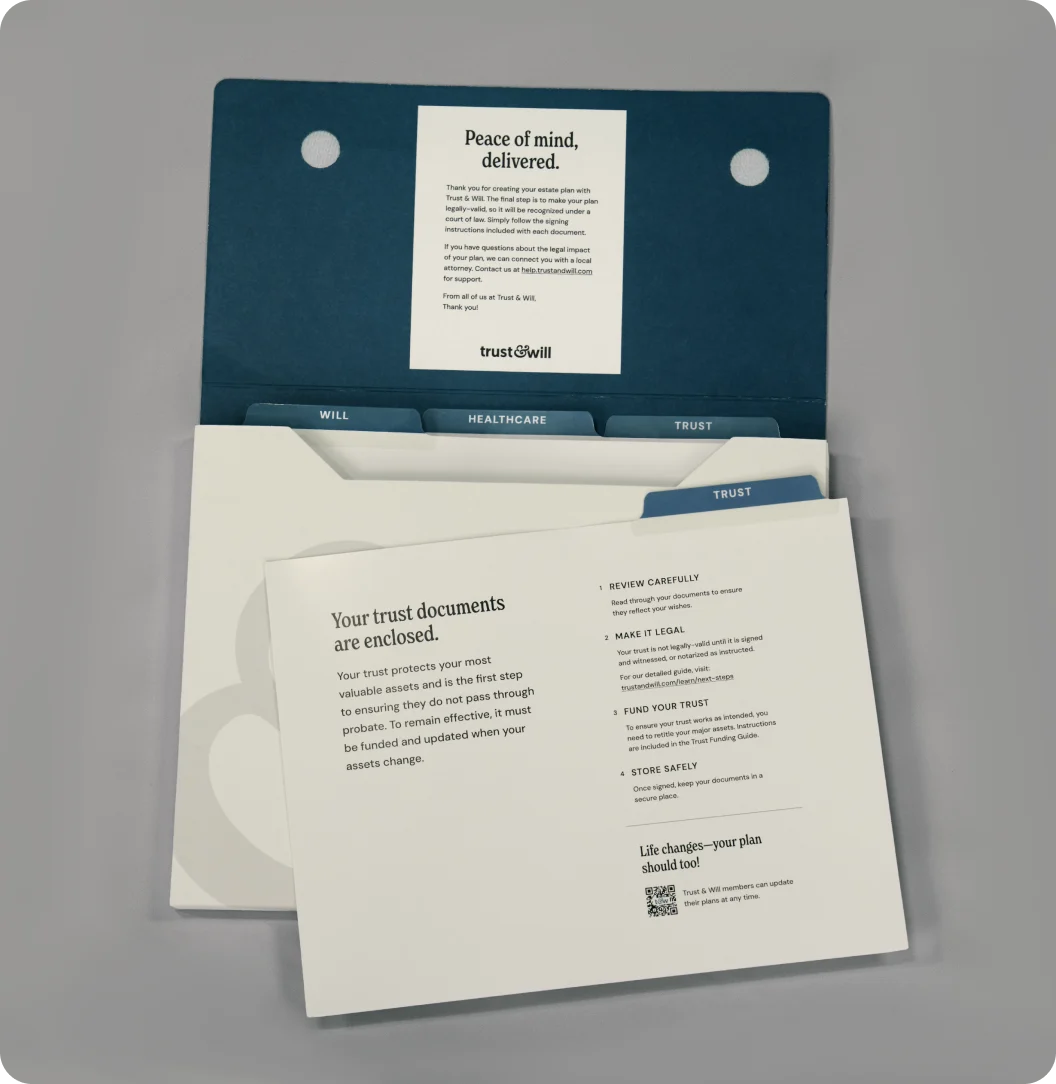
Instantly download your Trust documents, or have them shipped to your door.

3

Sign and notarize at your convenience.

Finalize your documents and make them legally binding with your signature and a notary.

4

Fund your trust.

Assets you transfer to your trust fall under the protections and provisions you’ve outlined. We’ll provide a handy guide to walk you through everything you need to do.

Our Revocable Living Trust Features

The online Living Trust built for the future.

Designed by attorneys, customized by you.

Every document in the Trust Plan is built by estate planning attorneys and written for the laws of the state you live in.

Update or revoke it any time.

A Revocable Living Trust stays under your control for your whole lifetime — change beneficiaries, trustees, or terms whenever life changes.

A guided path to funding.

Creating the Trust is only half the job. We walk you through transferring real estate, accounts, and other property into it, step by step.

Membership keeps your plan current.

For $49/year you get AI-powered answers, a secure Digital Vault for important documents, and one free document shipment per year.

Member Reviews

We’ve helped over 1M people secure their legacies!

★★★★★
“Don’t let your fears and concerns about the process stop you from completing this important step. You’ll be so glad you did it.”

We decided to create an Estate Plan after going through significant life changes: getting married, having a baby, and buying a home. We felt like a weight lifted knowing our wishes would be honored.

— Brendan Sweeney, member since 2020
★★★★★
“After my Estate Plan was complete, I felt reassured that my family would be cared for if something happened to me.”

Trust & Will supported me from beginning to end in creating my documents. I filled in the blanks with what was important to me, then they reviewed it and sent me a printed copy.

— Sara Hennessy, member since 2020
★★★★★
“We’re so relieved our Estate Plan is done!”

Trust & Will made the process so unbelievably simple! Our main concern was that putting together our Estate Plan was going to be tedious and expensive, when in fact it was the opposite.

— Monica Luna, member since 2020

FAQs

Common questions.

What is the difference between a Trust and a Will?

A Revocable Living Trust is the most comprehensive Estate Plan and offers people more control over when and how their assets are distributed. Trusts also allow you to avoid probate court.

A Will Plan lets you nominate guardians for your children and specify your health care preferences, final arrangement wishes, and how you want your assets distributed.

Compare the two plans side by side.

How long will it take to complete my Trust?

Through Trust & Will, it takes as little as 30 minutes to complete your Trust.

Does my Trust have to be notarized?

Notarization is required for most Living Trusts. It may be possible to create a Trust without notarization, but most states require that the Trust be notarized in order to hold real property. Additionally, many banks and financial institutions will require your Trust to be notarized.

A Trust, unlike a Will, does not need to be signed in front of any witnesses unless you live in Florida.

Can I speak to an attorney about my Trust?

While it is not necessary to hire an attorney to create a legally-valid Trust, we do offer our members Attorney Support for an additional fee when you create your Trust through Trust & Will.

When you add attorney support to your Trust-Based Estate Plan, you have unlimited access to an estate planning attorney. They can provide you with legal advice, discuss any tax consequences associated with your decisions, and review your documents.

When should I update my Trust?

We suggest that individuals review and/or update their Trusts after any life milestone or every three to five years. Milestones can include: marriage or remarriage, the purchase of new property, and any births or deaths in the family.

How do I fund my Trust?

How to fund a Trust varies depending on the nature of the property that is being transferred into the Trust. We break down all of the necessary steps it takes to properly fund your Trust so that you reap its benefits in our Trust Funding Guide.

What is the difference between a Revocable and Irrevocable Trust?

A Revocable Trust is a Trust that can be revoked, meaning it can be changed or updated at any given time as long as you are still living and of sound mind.

An Irrevocable Trust cannot be easily amended, changed or terminated once it’s signed.

Should my spouse and I have separate Trusts?

Whether or not to have joint or separate Trusts will be up to each couple as each option has its own pros and cons. Separate Trusts may be beneficial for couples who own separate property from previous marriages or family inheritance.

Joint Trusts might be the right choice if you want more flexibility and less complication during the post-death administration process.

Are payment plans available?

Yes. Payment plans are available for both Will and Trust-Based Estate Plans. Complete your documents and make 4 equal, interest-free payments.

Ready to get started?

Join over 1 million Americans who have created their estate plans with Trust & Will. Get started in minutes.